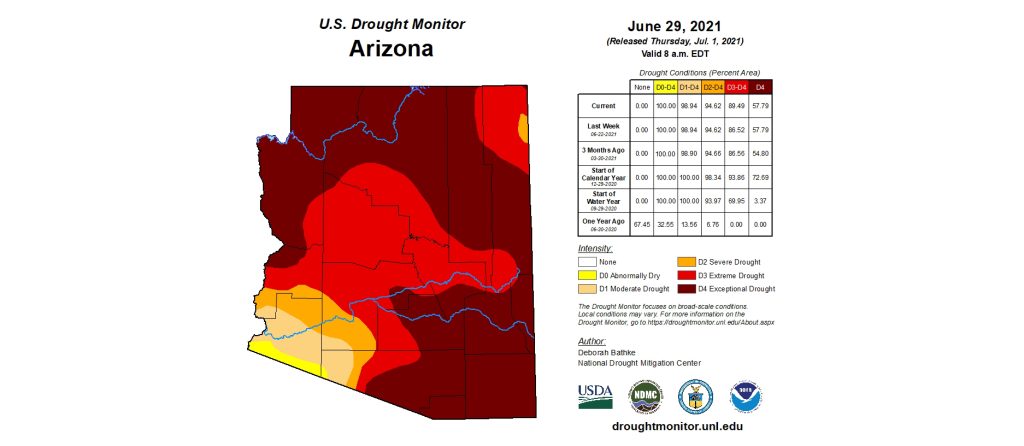
By L. Parsons The entire country has been experiencing an unprecedented heat wave over the last month and Navajo County is no different. The week of June 14, Winslow alone set several high temperature records. Brian Klimowski, the Meteorologist in Charge at the Northern Arizona Office of the National Oceanic and Atmospheric Administration (NOAA) said, “This is highly unusual. Many parts of the state saw record highs on multiple days. That rarely happens. We had a huge, strong high-pressure cell settle over the area for a number of days and that’s what brought the hot temperatures and dry conditions. Some of the statistics show that the area may reach over 90 degrees a few times a year on average, this year it happened five days in a row. That’s only happened four other times.” Winslow and Holbrook both hit record highs of over 106 degrees every day from June 13 through 19, according to Klimowski. “The number of days that you all usually get over 105 is almost zero. That never happens. Before the year 2000, you would never reach 105. Now, you are hitting it maybe twice a year on average. This year it’s already been over 105 eight times. The most it has ever been.” Klimowski said, “This will vary every summer from here on out. However, the frequency of record high temperatures will continue to increase each year. That is one of the telltale signs of climate change.” The combination of the drought conditions, warm temperatures and static lightning are only increasing fire risks and affecting farmers and ranchers in the area. Navajo County Emergency Manager Katrina Jenkins said, “The long term effects of drought on fire conditions is inextricably linked. As the vegetation both in and around the forests throughout the state clearly indicate they are in desperate need of moisture. After a dismal monsoon season in 2020 followed by a very weak winter season, our forests and grazing areas are currently in ‘extreme’ and ‘exceptional’ drought conditions. According to Jenkins, these drought concerns have major impacts on the agricultural community members. “Farmers and ranchers both need the precipitation to avoid major economic impacts through loss of crops and livestock. Along with forest closures, the timber industry is affected when they are not allowed to proceed with business. Water services are also impacted as groundwater levels decrease. All of which have direct economic impacts to the consumers through higher prices as costs for production increase.” Klimowski did have a positive outlook, however. “We do have some moisture and storms coming soon. We are starting to see encouraging signals that a more robust monsoon may be on the horizon. We don’t see any signals that we will be drier than normal. We should be off to a decent start in early July.” Despite the forecasted precipitation, drought conditions are not likely to improve. “A whole lot of rain would have to fall for a long time to pull Northern Arizona out of the drought we have been experiencing all of these years,” said Klimowski. According to the NOAA, this week’s temperatures are on the cooler side and Navajo County can look forward to highs in the upper 90s for Winslow and Holbrook and upper 80s in the White Mountains with partly cloudy skies.