

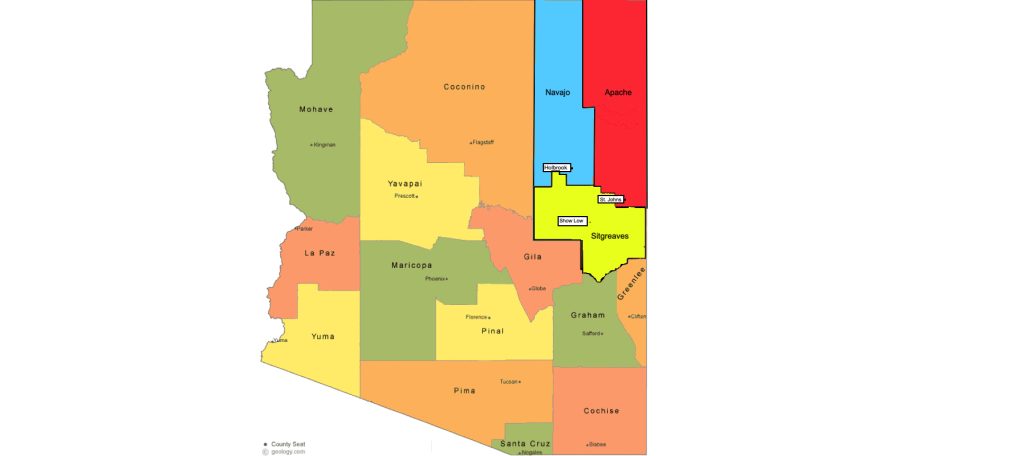
By L. Parsons Last week, the Arizona Senate Appropriations Committee allocated $500,000 to the formation of a study committee on the proposed Sitgreaves County. The language of Senate Bill 1653 establishes a 13-member joint study committee on county boundaries. The bill requires the committee to research and report on the fiscal and related impacts of a change in the county boundary line between Apache County and Navajo County to create a new Sitgreaves County. The new county is being proposed as a way to “decentralize” Navajo and Apache counties, according to Jesse Valencia who is spearheading the endeavor. District IV Senator Wendy Rogers (R) sponsored the bill in the committee saying, “I’m kind of the vehicle of this bill. It is otherwise known as the Northeastern Arizona Development Act and the primary result of it, when it finally reaches completion, will be the creation of a new county. The current county boundaries are archaic at best and not really representative of the real geography, environment or the demographics of Apache or Navajo (counties). “Interestingly, the pandemic has shown that these counties as they are could be definitely improved by the creation of Sitgreaves County. Secondly, the needs of the citizens of Navajo and Apache have not been met through this pandemic, which has seen over 10 percent of its population affected by the virus. We have come up with this study committee bill to determine the feasibility of creating this county and obtaining much needed data about both counties.” Rogers explained that redrawing county lines could allow more state funding to come into the area. She said, “It will increase state funding to the entire region while also being fiscally responsible. It will give each county its own responsibility to make decisions specific to its regions. It will also increase indigenous representation in county government.” According to Valencia, the inclusion of indigenous voices from all tribal communities involved is important. However, as he pointed out, “The tribes themselves have not been consulted on this plan. It’s been a personal research project of mine and some county leaders who (have desired) their own county for some time. The tribal regions would not be left out. The White Mountain Apache Tribe would comprise about half of what Sitgreaves County would be. Each county would have substantial numbers of indigenous populations and the county would effectively not affect those in any way. It is not a segregationist plan.” Valencia has spoken many times about the reasons for creating a third White Mountain area county. This time, he mentioned the COVID-19 pandemic saying, “When the pandemic hit we, The Sitgreaves County Project lobby, saw how difficult it was to get resources from north county where the county seat is in Holbrook, to the south county and those who needed them.” Valencia has also cited other reasons over the years. Those include emergency response to rural areas, public safety and varying environmental needs. He explained in an interview with The Tribune in 2018. “The largest recipients of county money are schools and highways and things like that; new county lines would be drawn around school districts. People down here are tired of having taxes raised. So they will reject a good, smart tax like the jail district tax on the last ballot. The idea is (that) instead of trying to force this, and people continue to be mad, (instead) why not design new county boundaries that will benefit all three, where each is able to stand on its own feet without too much help from the state and be able to work within themselves toward their own futures. I thought, we decentralize the power structure of Navajo and Apache counties and divide them into something that actually works for the people who live there so there’s not a tug of war between the people.” Valencia and supporters of the Sitgreaves project, including Rogers and State Representative Walt Blackman (R) have been met with opposition by local leaders as well as in the State Senate. Before Valencia addressed the committee, Arizona State Senator Sean Bowie expressed concern for the lack of indigenous input. Based on Valencia’s research he stated, “Native American representation at the county level in all three counties, and in county government, and tribal interactions with all three county governments will increase. This is because of decentralization, not secession.” Valencia also explained the origins of his idea to form Sitgreaves County. “The Sitgreaves County Project began when I was working on my first screenplay, “In the Land of Good Oaks,” and I decided to base it in a fictional version of the White Mountains where I live. The film itself is going to be a vehicle for my band, Gorky, and was my thesis screenplay at the David Lynch Graduate School of Cinematic Arts.” He continued, “However, while I was world-building for the film, I discovered in my research that creating the county could actually be possible. Not only that, but I found out a lot about Navajo and Apache counties that convinced me it would be a good idea to do so. The fact that stood out the most was that these counties are the only two counties in Arizona that have been consistently in poverty.” Valencia stated his main purpose for creating Sitgreaves County and for continuously working toward changing the minds of politicians and stakeholders is, the people. “I would not be in this if I didn’t believe it was in the best interest of the poor people that I live amongst.” The passing of the Senate bill allows the study committee to be created. There is no time line on when it will take hold or begin the multifaceted research needed to determine feasibility of Sitgreaves County. Navajo County leaders were not available to comment on the proposed county decentralization, but updates will be available as the situation unfolds.




