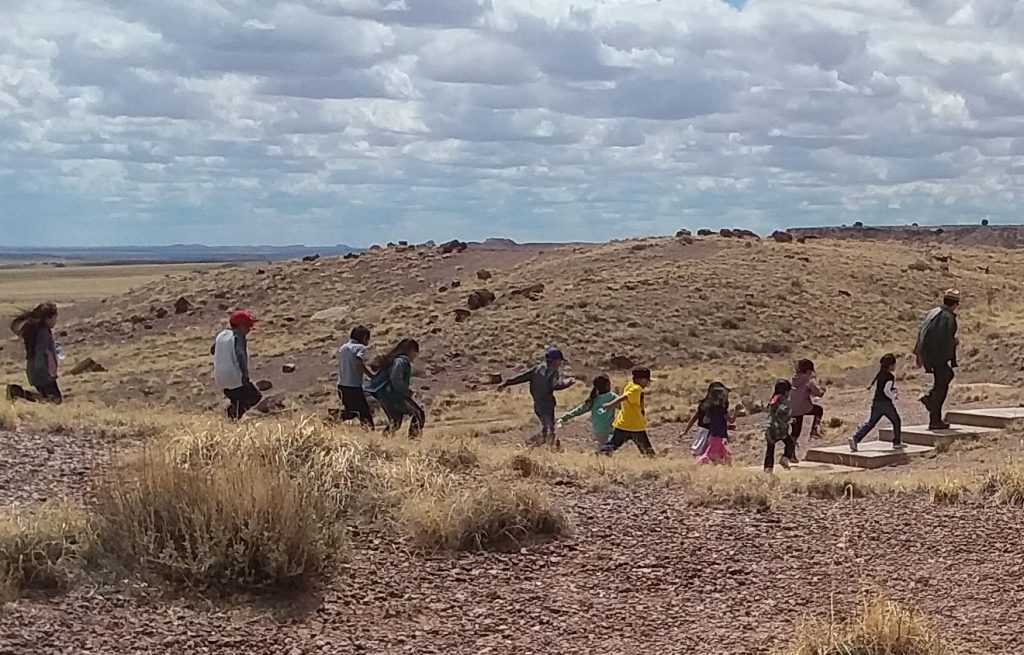
When visiting the petrified forest national park, it’s hard to miss the vibrant landscapes, the clusters of petrified wood throughout or the scenic drives through millions of years of history. According to PFNP Education Specialist Ricardo Escobar, the view is only a portion of the experience when considering the diversity of education, the area so naturally provides.
Escobar explained that while every national park has an environmental education program, PFNP is hyper focused on it, especially where youth and educators are concerned. He believes that PFNP is the perfect setting for kids to begin nurturing their curiosity surrounding the makeup of the Earth’s history.
“Public land sites are the perfect natural lab setting to really immerse students in the sciences that we know lacks diversity. Here we’re lucky we are in a pretty diverse area. We’ve got several reservations close by. We’ve got a big Latino makeup in Holbrook. So, to diversify the science, we need to expose the youth to those topics early on. We are so privileged here in the Petrified Forest to be able to have archeology, ecology, paleontology, geology and modern history.”
Ricardo explained that PFNP has structured a number of programs tailored to enhancing the understanding of the area by increasing the amount of citizen science opportunities, saying that it’s one of the true ways to actively engage visitors and get them invested and make them feel like they are making a contribution to the park.
One of the programs is the Student Phenology for Outside Citizens (SPOC). “What we teach the students is how to make natural history observations, either of wildlife or plants. I teach them how to identify what they are viewing and also to determine what phenology state they are in.” For instance, if a plant is getting ready to bud or bloom, he teaches them how to identify that.
Students upload the information from their findings onto an app called iNaturalist. As part of the program, visitors can contribute to the data collection at PFNP. When they do a project there are designated places they can select and submit their information to that project. “Any visitor can come and make an observation and submit it to iNaturalist and submit it to our project so that our biologist can use that data for research purposes. Our data that we collect with these students is actually used by our biology staff,” said Ricardo.
As part of their educational program, the park created a culturally safe learning environment to ensure everyone has the same learning opportunities with simulated fossil digs. It provides the learning tools to uncover replica fossils and bones. Escobar explained that prior to his employment there, PFNP used a mixture of replicas and real fossils but due to cultural sensitivities they now only use replicas as a courtesy to those who have cultural boundaries. He explained that certain cultures prohibit the handling of things like bones, snakes and pottery to name a few.
“We use replica fossils because we’re right next to a lot of native reservations, Hopi and Navajo, and due to cultural sensitivities, we don’t want to necessarily expose students with those backgrounds to anything that will make them uncomfortable. We try to be aware and sensitive to those kinds of things,” said Ricardo.
The program also offers simulated archaeology digs where they find artifacts. Ricardo said that since joining the team at PFNP two years ago he hasn’t seen anyone schedule one. He believes that like the fossil digs, it’s because of cultural sensitivities but hopes to have some in the future.
For those who wish to dig in and find real fossils, they can go to the field institute at PFNP and sign up for one of their public dig days, which typically start around April or May when the weather gets warmer.
The park also has a program that focuses on geology. “We teach the students how to observe the landforms they see out here and make inferences of what types of rocks they are.” For instance, they teach the students how to determine different types of rocks and the characteristics that distinguish the different landforms such as mesas and rolling hills.
While the Petrified Forest has a lot to offer the educational system it does require a level of dedication to ensure that there is funding available to continue their mission of inviting more people to learn about the importance of the work done at PFNP.
One of the biggest hurdles the park faces when offering programs is the transportation cost. With an average of 50 miles one way it can cost up to $800 for one bus to transport a load of students. As part of his dedication, Escobar seeks out yearly grants from the non-profit National Park Foundation. He uses the attendance statistics from the previous years as part of his proposal and submits it when the grants open to secure funding to provide the transportation.
Escobar explained, “It’s on a first come first serve basis and they do run out, so after that, the schools are unfortunately on their own to fund themselves if they can and I don’t want that to be a thing anymore. I want everyone to have the opportunity.”
Escobar said that in 2018 they received an $8,000 grant and in 2019 they received a $10,000 grant. He says he plans to use the growing attendance as part of his argument to increase the amount they ask for next year.
I expect that we’ll get more than 2,000 visitors this year. Escobar said it’s obviously about the quality of the education not necessarily how many people they get but it is important that more people realize they can access the space to help meet their educational needs.
“I really want to see an increase in local colleges utilizing this space. Right now, I only have one professor, Pat Lopez from NPC (Northland Pioneer College) that I’m aware of that is utilizing the area.” Ricardo explained that Lopez teaches Intro to Biology and talks to students at PFNP about ecosystems in the area.
“If there’s a professor teaching intro to archaeology we’ve got the resources right here. Why not come and study it here? If there’s someone teaching history, like Arizona state history, you’ve got it right here and it’s free.” Ricardo said that any educational group who can provide the documentation that shows that, they get in free. They just need to contact him for a fee waiver.
Although they do have specific agendas for each area of study, Escobar said they are not opposed to switching things up. “We are also open to tailoring certain programs to fit certain academic goals or requirements that a teacher or school may have,” said Escobar.
Recounting one instance where a hiking club from Snowflake took a scheduled trip with him customized to their learning goal, Escobar shared, “We had about 18 high school students and we hiked out to the Onyx Bridge and talked to them about the Wilderness Act and what it means, leave no trace principles, how to orient themselves with a map.” He said he hopes to do more hikes and structured programs with local educational entities.
Anyone who would like more information on the educational programs offered at PFNP can locate the information at www.nps.gov.