/wp:paragraph
wp:paragraph
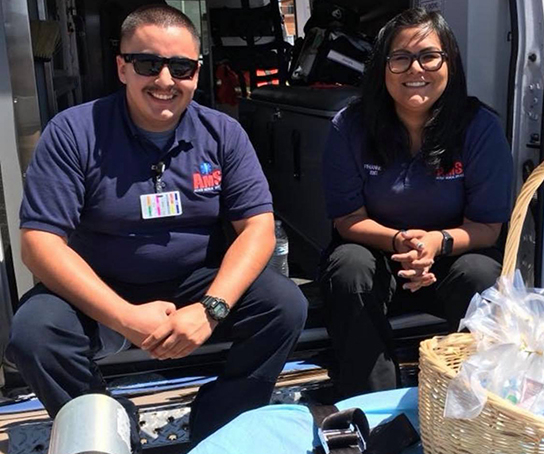
The job of an Emergency Medical Technician (EMT) isn’t a typical day at the office. It’s about serving people when they need it most and saving lives in dire situations. Matthew Sanchez serves as an EMT in Winslow and as he came off of a 72-hour shift, he explained what his job entails.
/wp:paragraph
wp:paragraph
“From the moment we walk in the door, we are responsible for responding to 9-1-1 traffic. We also do inter-facility transfers, so we move patients from Winslow to larger hospitals and trauma centers,” he said, adding, “We never know what our days will bring.”
/wp:paragraph
wp:paragraph
Sanchez said the exciting part of the job is that each day is different but on the other hand, there’s also a great deal of stress. “Being on the clock for a minimum of 24 hours straight is typical of EMTs in most agencies. When I tell people I do 72 (hours) at a time, they look at me like I’m crazy.”
/wp:paragraph
wp:paragraph
During his three-day shifts Sanchez lives at the station, eating, sleeping and showering there so he is always ready for the next call. “Sometimes, you’ll just be sitting down to dinner and the tones will drop, or you just fell asleep. Somedays, there are like one or two calls. Other days, there are 22. Sometimes, you end up doing what we call a ‘stand up 48,’ which means you had so many calls you didn’t sleep at all. It’s all just part of the job.”
/wp:paragraph
wp:paragraph
According to Sanchez, on any given shift, there are anywhere from four to six people working. “We partner with surrounding emergency medical service agencies and there may be times when we have to call Holbrook or Guardian Air Transport. We cover I-40, and Highway 87 and there is a lot of travel along those roads.”
/wp:paragraph
wp:paragraph
Sanchez said he and his fellow EMTs face mass casualty incidents that are difficult to handle but they are trained to do so, even with just four to six people on hand. The calls Sanchez and the other EMTs take vary widely. He said, “We see everything from a stubbed toe, to people exposed to the elements, to pediatric codes where we walk in to a place and there is a child not breathing.”
/wp:paragraph
wp:paragraph
Sanchez began his career as a first responder with the Winslow Fire Department before moving over to the medical field. He has been an EMT for two years and says he has seen patients that have had lasting effects on him. “Just like anyone who is a first responder, there are certain negative drawbacks to the job. My personal struggle is the pediatric codes. Taking the trauma home with me, so to speak, and then not really being able to talk to my family about them weighs heavy on my heart and my mind. I live with my grandmother. She tries to sympathize but, unless someone has seen what we have seen, they cannot fully understand. I find the most comfort in talking to other EMTs or trauma nurses or paramedics. Those that have a true understanding of what goes on out there.”
/wp:paragraph
wp:paragraph
Despite being trained to respond to emergencies of all types, Sanchez said, “It’s not the response that is difficult. I know what to do, I know how to save lives. It is the psychological aspects of what that entails that is hard for me.”
/wp:paragraph
wp:paragraph
He recalled, “My first call that involved a child ended up being ruled a homicide. My partner and I administered chest compressions and breathing for longer than we would have on a person in cardiac arrest. Probably because it was a child. We tried for 45 minutes, until we were sure there were no changes. And then I had to go back to the station and get ready for the next call.
/wp:paragraph
wp:paragraph
“Humor is my coping mechanism. Your average, everyday person can’t see what we see and then go about their business, or go to lunch and have a sandwich. We have to do what we have to do and be ready to respond to the next call. Beyond that, we have to be able to go home to our families and friends and be a ‘normal’ person.
/wp:paragraph
wp:paragraph
“We do a debrief after those calls. But, honestly, being able to talk and joke with my partner is so important. I also have a strong connection to my colleagues in the emergency department that help by telling me that it gets a little easier with time and experience. I am not sure how to not be affected by my job, but I know I am in the right field. I feel like this is my calling.”
/wp:paragraph
wp:paragraph
A career in first response was always on the radar for Sanchez. He said, “This job chose me. When I was a kid, I wanted to be a police officer, but (Winslow Fire) Chief Hernandez called me and asked me to join the fire department. After getting my certification, I did hire on to the department. We went on car accident calls and I realized that the humans involved, the trauma patients, were where I wanted to help. A year later, I became an EMT. I also work in the emergency department at the Little Colorado Medical Center as an ER Tech, which is basically an EMT but in the emergency department. There, I am responsible for monitoring and responding to every patient that enters the department.”
/wp:paragraph
wp:paragraph
He is not finished advancing in his career. He plans to begin training for his paramedic certification in January.
/wp:paragraph
wp:paragraph
“To get an EMT certification, it is only one semester. That semester is full of classroom work as well as field work. After you are on the job, you have to constantly be taking classes and trainings to maintain that certification. I am both state and nationally certified. The paramedic program is longer, it is a year long and it’s a huge step. Because, not that I’m not responsible for people’s lives now, but even more so as a paramedic because any decision I make will directly affect my patient’s life. Paramedics have a wider scope of practice. They can start IVs and administer medication, intubate in the field. Paramedics are basically field doctors.”
/wp:paragraph
wp:paragraph
Sanchez currently has three days off in a row, “It is unheard of, but I will take it,” he said. “I need that down time to decompress and enjoy my friends and family. Just remember, that we are out here to help, and we all treat every call with the same intensity and dignity. No matter if you call because you threw up or your kid feel out of a tree and broke his arm. We are first responders. It is what we do. We are always ready for the next call.”
/wp:paragraph