

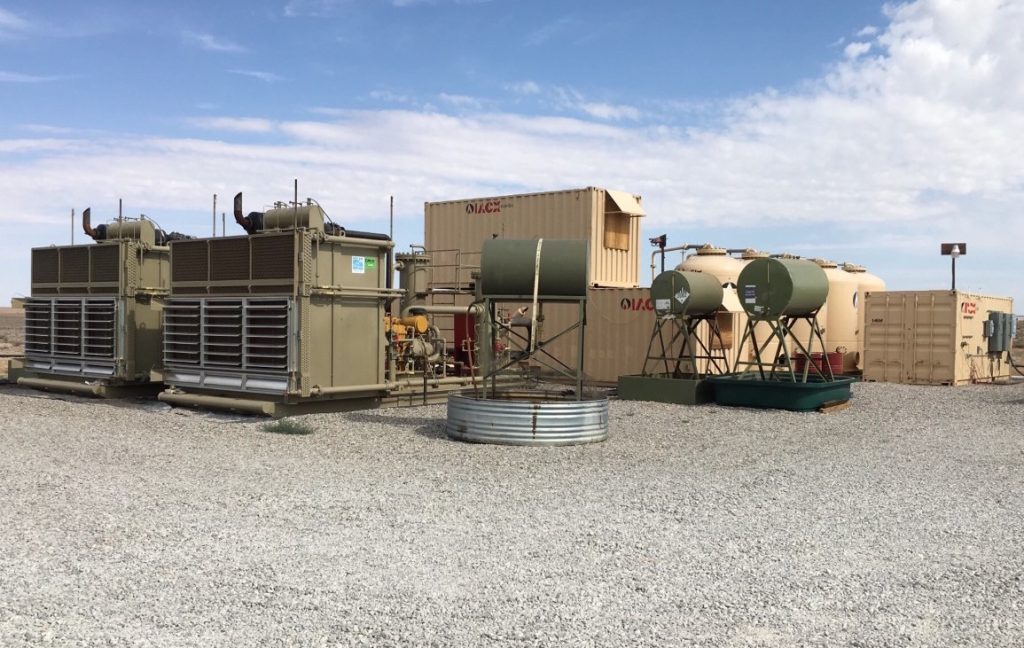
“Heliopolis’ time has come!” is the statement proclaimed on the Desert Mountain Energy Corporation (DME) website. DME was the winning bidder at $2 an acre for two of the three oil and gas leases offered by the Bureau of Land Management (BLM) in Navajo and Apache counties on Sept. 6, despite public protest against the leases.
One of the leases was for 2,400 acres south of Woodruff in Navajo County with the second lease of 640 acres on the northeastern border of the Petrified Forest National Park (PEFO) in Apache County.
Under the Trump Administration, oil and gas leases are being fast tracked with little to no regard as to environmental impact or destruction of ancient artifacts and historic properties. It is a move that those in opposition believe threatens not only the quality of water, land and air in Navajo and Apache counties, but also brings into question the rights of state and private landowners.
The new American Energy Dominance policies of the Trump Administration are allowing procedures to be expedited, bypassing input from other agencies and the public as noted in a memo posted by the BLM on their website on Jan. 31, 2018, which may be viewed at www.blm.gov/policy/im-2018-034.
The result brings the possibility of a project like Heliopolis, the name DME gave their Holbrook Basin helium project, and the potential for great change; but until an environmental impact study is completed, no one will know what that change will be.
Named Heliopolis after the famous ancient Egyptian city, the seat of worship of the sun god Atum or Ra, the DME website notes that there are 36,702 acres of key helium prospects under lease in the Holbrook Basin. Heliopolis is touted as the “world’s best address for helium: ‘The Saudi Arabia of Helium.’”
While DME has done studies of the geology, none of the required studies by the National Environmental Policy Act (NEPA), which was signed into law in 1970, have been done to assess the environmental impact of the well-drilling and potential fracking in the area, including the impact on PEFO.
In an interview with Arizona BLM spokesperson Adam Eggers, in June of this year, he said, “A long time ago, we used to do the public protest and the environmental impact studies before the lease sales, but in an effort to save taxpayer money, we now do that when we receive an actual application for drilling.” But questions are now arising as to whether the whole 10-day protest period was nothing more than a dog and pony show put on by the BLM.
As noted in a protest letter submitted by Kevin Dahl, Arizona senior program manager with the National Parks Conservation Association (NPCA), the public notices posted by BLM were only at their offices and on the BLM’s website where the information was difficult to find. Further, BLM only accepted the protests through the outdated technology of faxing, no email submissions were allowed. Nearly 10,000 emails submitted by the NPCA’s membership alone are being excluded from the protest.
Dahl later shared, “My concern is that these leases were done under an expedited procedure to increase our energy dominance. There is no procedure for companies to lease public lands to extract helium, so they must use oil and gas leasing rules. Rather than involving the public in regular environmental compliance, the BLM used the Phoenix Resource Management Plan – a study that is 30 years old. There were no environmental studies. There was no consultation with the Navajo, Hopi and Zuni tribes, which is required by law.
“One lease is close to the Little Colorado River and the other is on the Puerco River, which is upstream from PEFO and close to the railroad. If there is a hazmat problem, the watershed for 20 million people could be seriously affected.”
While fracking is a concern, the greater concern is the apparent refusal by the federal government to play by their own rules; rules that started in the 1970s and have been amended and updated into the new century.
As Dahl said, “Since the 1970s the federal government has done environmental studies to insure that every agency and the public are aware of the impacts. Public hearings are held and people have an opportunity to be a part of the final decision.”
But now the procedure is being streamlined to exclude the public and Dahl believes that if this is happening on a federal level, where it’s easiest to bring compliance, it does not bode well for rights of state and private land owners in the face of this oil and gas takeover, especially since most private land owners only have the surface rights to their land, as the subsurface rights where gas, oil and minerals reside, were often sold decades before.
With the worldwide market for helium approaching the $1.5 billion mark and a projection of sharp growth, it’s no wonder that the rich helium reserves in the Holbrook Basin are slated for harvest.
Able to produce some of the highest quality helium in the world, the Holbrook Basin covers approximately 160 miles by 100 miles and includes the areas of Holbrook, Woodruff, Snowflake, Taylor, St. Johns and Springerville.
A presentation on Heliopolis on the DME website ends with, “Work program for 2018 include: Mapping, two-dimensional seismic survey; multiple drill targets ranging from 1,500 to 4,000 feet. First well targeted for Quarter Four 2018; long-term development contemplates potential drilling of 50 wells at Heliopolis.” There is no mention of environmental impact studies.
Helium, which is non-flammable and lighter than air, is the new rare tech gas. Helium plays a critical role in the manufacturing of high capacity hard drives, barcode readers, computer chips, semiconductors and fiber optic cable. It is also used a refrigerant in cryogenics research and a coolant for nuclear reactors, MRI machines and space vehicles.
Extraction of helium is initially done through standard gas and oil wells, with fracking as an end use to get a final push of gas out of the well.
The helium site operated by Ranger Development in Apache County south of Interstate 40 near Exit 325, has been drilling since 2016 and on Jan. 16, 2018, received their Aquifer Protection Permit from the Arizona Department of Environmental Quality, giving them the right to frack.
As was noted in a letter dated July 16, 2018, to the BLM, Dahl said, “Throughout the west, and particularly in Arizona, the balanced management of the complex landscape is critical to ensuring that our natural wonders are protected, local and state economies grow, public health is safeguarded and our cultural heritage continues to be part of our collective spirit. These shared goals can only be achieved through an inclusive, collaborative process that allows the public to be a participant in managing their public lands.”
Dahl also said the greatest concerns of his organization are the cumulative impact of the extraction of helium. “How much water does each of these wells take? What does that do to water resources? The second concern is the pollution of noise, light, traffic of trucks, impact on historic bridges and roads as well as the impact on the wildlife and plants.
“The communities should know what we are giving away when we sell these leases,” continued Dahl, who strongly believes the actions of the BLM were illegal. “It is only a fair compensation that the studies be done and the law needs to be followed.”
In contrast to the Arizona land lease sales, in New Mexico the BLM put 71 parcels totaling 28,036 acres up for bid for oil and gas leases. The total receipts were nearly $386 million. Forty-eight percent of those sales will be returned to the State of New Mexico to help fund roads and schools.
Information on DME can be found at www.desertmountainenergy.com. Information on BLM can be found at www.blm.gov.
Information was requested from the BLM and from DME. At the time of press, there was no information forthcoming from either entity.




