PETRIFIED FOREST — Set among the area known as ‘The Teepees,’ the red, blue and gray layered cones of earth, rock and ash rising above the sea of grass, sage and rabbit brush in the Petrified Forest National Park (PEFO), is a place called the Dying Grounds.
On Aug. 25, as part of the 2018 BioBlitz, PEFO Lead Paleontologist Dr. Adam Marsh took a small group of people on a hike to this place where the elevation was measured not in feet but in millions of years, and where the remains left behind from this ancient world of the Triassic Period barely resemble the more commonly known dinosaurs which followed 50.6 million years later in the Jurassic Period.
Marsh noted that the hike was beginning at the 223 million year mark in the Chinle Formation and would end at the 220 million year period. He also said that many of the rock layers in the region were named in honor of the tribal heritage that surrounded the area.
The hike began on an abandoned road that was built in the 1930s by the Civilian Conservation Corps and past the place where Annie Montague Alexander, Hawaiian sugarcane heiress, camped with her partner, Louise Kellogg, during the summer of 1921 in her quest to understand and preserve paleontological artifacts.
The group continued through the maze of cones on a path most likely traveled by John Muir, who came to Arizona in 1905 for the health of his daughter and spent much time exploring the Petrified Forest area, gathering fossils while naming the Blue Forest and other features.
As Marsh led the group up the narrow path, he showed the frailty and strength of the elephant skin texture that blanketed the cones on either side. Created by altered volcanic ash it provided the protective covering for the rocks, petrified wood and fossils that lay hidden underneath. “Most of the bones and teeth, if they have spent any amount of time in the weather, turn blue or purple,” Marsh said, as he pointed out the difference between petrified wood and bone.
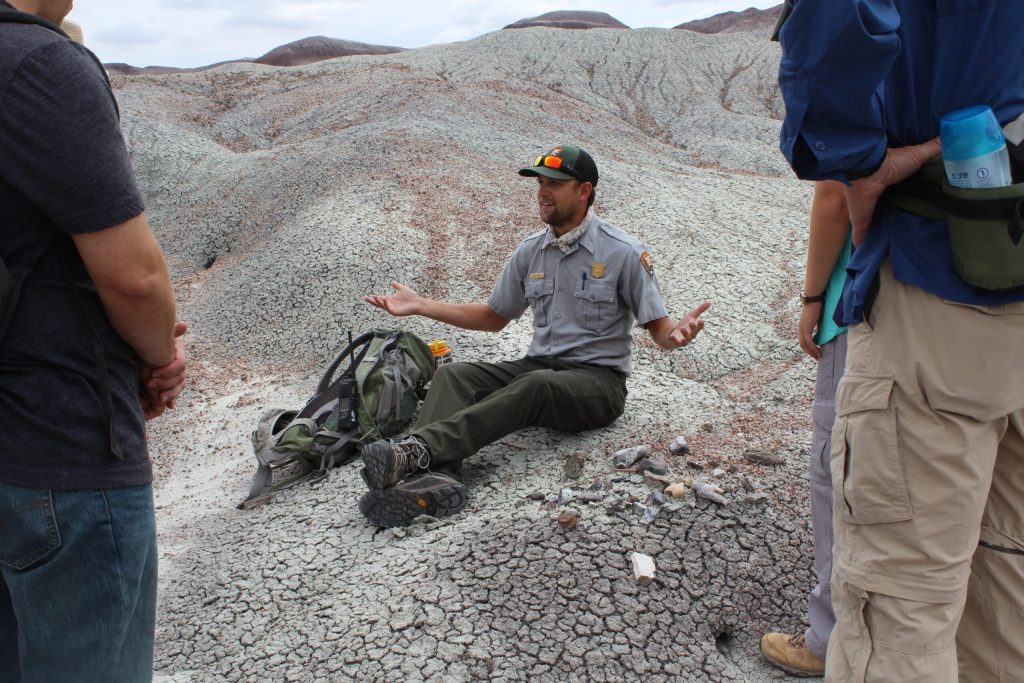
At one point, Marsh sat near a pile of what appeared to be rocks and began to recreate in the imaginations of those present the creatures who had once roamed this land millions of years before during Triassic period.
“The primary types of animals we get in the Chinle Formation belong to a group called archosauria, which includes birds and crocodilians,” shared Marsh as he went on to explain, “Here we don’t actually get that many archosaurs in this specific layer; most of what we get are earlier members of the same evolutionary lineage as archosaurs. Some examples are phytosaurs, which are either the earliest archosaur or they are right outside of that group. While most crocodiles have the nostril at the end of the snout, these creatures have the nostril close to the eyes.”
Marsh also said that there have been a number of amphibians found as well including the metoposaurs, creatures that have similarities to the salamander. “Think of a salamander that is about as long as Volkswagen Bug with a really squashed head covered in skin that is pocked like a golf ball,” said Marsh as he described the metoposaurs.
Continuing the hike, Marsh led the group into a large bowl-shaped area, the place where more than 900 bones had been found of animals known as malerisaurus. Marsh said that a similar animal was found in Madagascar and Morocco known as the azendohsaurus. “What we found here is the malerisaurus. They belong to the same group, think of them like evolutionary siblings. Malerisaurus was a dog-sized reptile with sprawling legs and a long snout full of sharp, curved teeth. It would look a little like a long-necked, long-snouted Komodo dragon.”
Leaving the Dying Grounds, the group traveled up a hill between Hoodoo Ridge and Camp Butte, to a place where a portion of a petrified tree rose out of the ash and earth. Marsh said that this was a reduced area that enabled the root ball of the tree to remain intact. It is also an area where soft bodied fossils are more often found.
As the group left the stark lands of the Dying Grounds, returning to the modern life of cars and roads, there was a quiet reverence of the ages that had passed.
As Marsh shared, “What makes the Petrified Forest special is that it is not covered by forests and vegetations like so many other areas in the nation.” The lack of vegetation makes the journey of discovery into the remains of these lost worlds attainable, giving scientists a chance to find the one percent of life that has been left behind.”