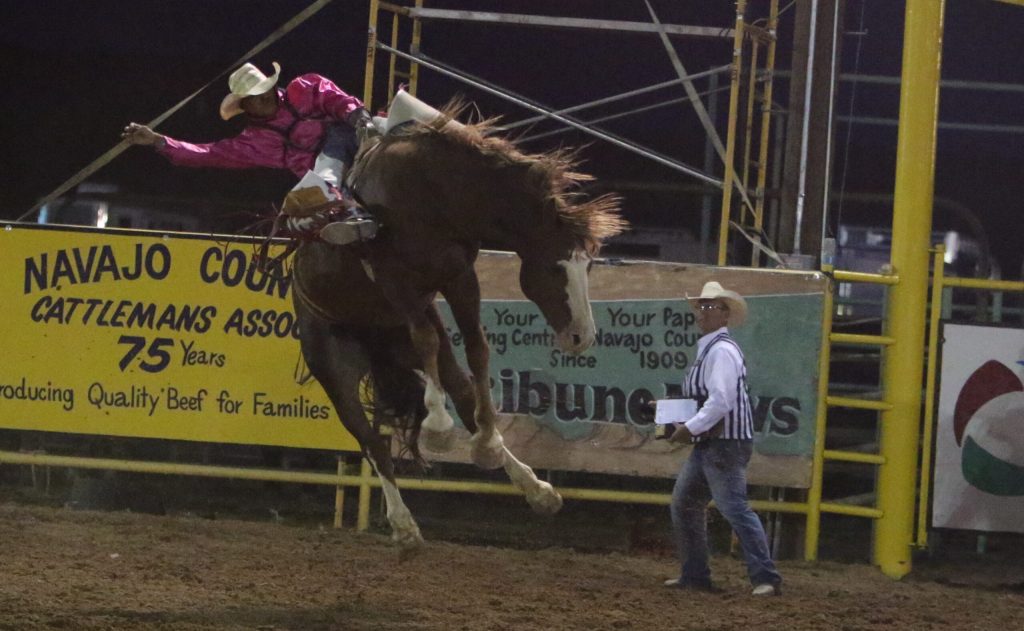
TAYLOR — “I love all rodeos and I love all aspects of rodeo; the ranch rodeo is definitely a different flavor of rodeo,” said Justin Burt, one of the coordinators behind the Fifth Annual Taylor Sweet Corn Festival Ranch Rodeo that will start at 6 p.m. on Saturday, Sept. 1 at Taylor Rodeo Park.
The supplying of the steers and horses, along with a lot of the rodeo setup is the work of Miles DeWitt. DeWitt is a partner with his dad, Milo DeWitt, on a ranch in Rio Rico where they raise bucking horses. “Miles is a top hand,” said Burt. “Both he and his dad are bronc riders and Miles has taken the world champion ranch rider title several times.”
Burt said the town asked him a few years back to help out with the ranch rodeo, to which he said yes. Born and raised in the Snowflake/Taylor area, he continues the cowboy lifestyle of training and shoeing horses and building fences, but when the ranch rodeos start up in Arizona, Burt is there.
“I am on two different ranch rodeo teams and we have gone all over Arizona, from Holbrook to Casa Grande and Wickenburg, and into New Mexico. The biggest ranch rodeos in Arizona are in Casa Grande and Prescott, and they put teams in that are hard to beat.”
A ranch rodeo is not the standard pro rodeo where individuals compete for the top prizes in several well-known events; rather a ranch rodeo is about the teamwork required to get a task done on a ranch. The teams are typically comprised of four men who work together to complete a timed task commonly performed on a ranch. The horses, tack and equipment are what the men use in everyday life.
“It is more of a cowboy event,” shared Burt. “Everyone on the team has strong points. Some guys are good bronc riders, others are good ropers; the guys that are good at everything are those that usually succeed.”
Burt went on to say that the ranch rodeo is a place where the cowboys cheer each other on and while the competition is strong, the camaraderie among the guys is often stronger. “We are all good friends; we have a lot of respect for all the teams.”
This year, 10 four-man teams, including Burt’s team and nine others from all over Arizona, will compete in four events: stray gathering, trailer loading, wild cow milking and branding.
Stray gathering requires that all four members of the team start out on horseback. Two steers are let loose and when they clear a certain point in the arena, the timing of the event begins. Each team member must head or heel one steer; both steers have to be tied before time is called.
Trailer loading starts with the trailer in the middle of the arena with two members of the team are on horseback and two are on the ground. Two steer are let loose and the rodeo begins as the cowboys on horseback must head them both while the guys on the ground help to get them loaded.
Everyone loves the wild cow milking as this event requires a roper, a milker and two muggers. All four cowboys start out on horseback with everyone attempting to rope the cow. Once the cow is caught, the muggers work to hold the cow giving the designated milker a chance to milk her. The bottle is then run to the judges, who determine if the cowboy really did milk that cow.
The branding event is a little different from other places, according to Burt. The cattle are turned out to one end of the arena where a calf is sorted from the bunch by heading and heeling. Once the animal is caught, the head rope is used to tie the front feet while the back feet can be held by the cowboys. The animal is then branded with a branding iron dipped in chalk. Time is called when the iron is returned to the pot.
The top team in each event will get 100 percent payback of their entry fee. The overall top team, which is decided based on the compilation of all the scores, will receive the largest portion of the prize money and belt buckles. The second and third place overall teams also will receive a portion of the prize money.
After the team events are finished, the Open Ranch Bronc Riding is next in line with bronc horses supplied by Milo DeWitt. Burt said the bronc riding is Arizona-style. “They ride one-handed at all times. If they blow or lose a stirrup, they lose the event. The cowboy has to have total control throughout the ride.” The event is limited to 15 riders, each paying $100 into the pot, to which another $500 has been added.
Even the kids have a chance to compete in the Bronc Steer Riding competition. There are two categories: one for kids six to nine years old; and one for kids 10 to 15 years old. Burt said he and some of the other guys who take part in the ranch rodeos have kids who want to try it out. “Most of our kids want to ride the broncs and we wanted to give them a good starting point before they get on a bronc.”
The steers are saddled and tacked with bronc reins, and the kids ride out the wily animals, while competing for a prize. It costs $50 to enter and the top winner gets 100 percent payback with a belt buckle.
“Every year the rodeo gets better and we are grateful for that,” Burt commented. “I am extremely busy right now, but I work on this because I love rodeo, I love to compete and l love our town. I want to make it real clear that I have tons of help doing this. No one is getting paid to put it on. I am grateful for the support of the town and the many sponsors and volunteers that help us with this event.”
The cost to watch the rodeo is $5 per person, with kids seven and under admitted for free.