

NAVAJO COUNTY– “Before the board today is the reaffirming of the resolution for the sales tax for the jail district,” said Navajo County Board of Supervisors Chairman Steve Williams at the Aug. 14 meeting and public hearing for the Navajo County Jail District. The board unanimously reaffirmed the resolution to go on the ballot as Proposition 419 in the November election.
According to Government Relations Director Adam Wolfe, “The voters will be voting to approve a jail district excise (sales) tax of up to one-third of a cent per dollar for 20 years to be used only for jail maintenance and operations. The official language will be released with the publicity pamphlet at the end of the month.”
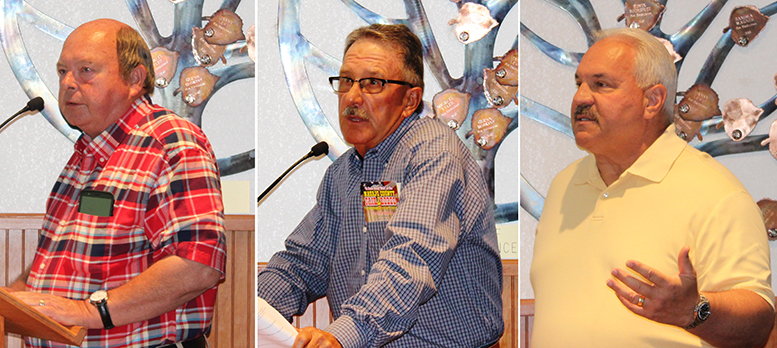
Three residents appeared before the board to speak at the public hearing including Tom Poscharsky, former mayor of Snowflake; James Molesa, former Navajo County chief deputy; and J.R. DeSpain, former Navajo County supervisor. Each gave their support of the jail district.
Poscharsky tackled the issue head on, stating, “The jail district can take away the jail fees of $425,000 being charged to the municipalities, it will also provide $4.25 million a year in sales tax. The sales tax base for Navajo County is $1.3 billion dollars.”
Porcharsky also noted, “Through economic development there are some things that may save the Cholla Power Plant for four or five years, but Pacific Corp., in their generation plan, is showing the closure of Unit Four in December of 2019. There is a good possibility you could lose Cholla at the end of next year if Arizona Public Service (APS) does not want to take on Unit Four or work out a deal with Pacific Corp.”
In his conclusion, Porcharsky asked that the jail fees not be reinstated on the towns and cities in Navajo County when this tax ends in 20 years. “I think the county needs to make county government a little more efficient. I am supportive of this, but I would urge you to be good stewards of the money and uses.”
Molesa shared his support, stating, “Good government costs money. No one has done a better job in my experience, both on the city and federal level, than Navajo County within the Sheriff’s Office and with the Board of Supervisors as being good stewards of our tax dollars. We literally invented the trend of doing more with less. The most important thing government does is to protect its citizens and to do that we need a strong criminal justice system, strong law enforcement, a strong prosecutor and a jail system that can accommodate the wishes of both.”
As the last speaker, DeSpain summed up his thoughts, saying, “It is difficult to balance those budgets and make those cuts especially when people’s lives are affected. I get a small cup of coffee every day and will be glad to pay the jail fees on that. We have a tremendous amount of tourists that buy products, which would help carry the burden for the citizens in Navajo County. I want to throw my hat in the ring and give you the support for the proposition and management of the money.”
Assistant County Manager Brian Layton summarized the Navajo County Jail District tax, reminding the board and the public that the financial problems for the county started in 2008 at the beginning of the recession.
“The county’s response during the recession is something we can be proud of,” shared Layton. “During that time revenues dropped and costs went up. We reduced staff by 16 percent and changed how we conducted business. As I shared before, having to tighten our belts and reduce expenditures is not a bad thing.”
This last year, the county was forced to cut two programs, Juvenile Detention and the County Attorney’s Child Support program. “These are things the public felt,” continued Layton. “All the job losses we have had to this point have been outside public safety, which has been very deliberate. And now as we talked about the closing of the Navajo Generating Station and Cholla Power Plant, it is a whole new time for us. With these closures, we will lose an additional $2.5 million on top of what we have already cut.”
Losing the coal revenue is equal to the combined budgets of the county’s assessors, treasurer’s, recorder’s and the superintendent of schools departments, and will cause a 20-25 percent reduction in the county workforce, including the Sheriff’s Office.
“Right now the budget is balanced,” added Layton, “But the loss of the $2.5 million will put us out of balance. The jail district is not a financial windfall for the county but it will help fill the gap.”
As Layton wrapped up his presentation, he reminded the audience that the jail district tax of one-third of a penny would not only provide the necessary funds, but would also eliminate the jail fees for the municipalities within the county which cost approximately $425,000 a year.
Sheriff KC Clark addressed the board, saying, “There is not a person in this room, including myself, who likes taxes. But what is the cost of public safety, to keep your family, your neighbor safe? It is expensive to keep the public safe. Not just the jail and law enforcement, but the county attorney, judges, probation, the list goes on and on. We have a safe community, we don’t have the problems in Navajo County or Arizona that they have across the nation. We have done well here.”
Clark said one question brought to him by a worker at the Cholla Power Plant was whether the County has taken into consideration the additional businesses in the Holbrook, Winslow and Joseph City areas that will be affected by the closures. “We will lose additional revenues from that.”
Clark continued, “There are 112,000 people living in the county and, of those, 50,000 to 60,000 are property owners. Those are the people that are paying right now for the jail. If we do the sales tax everyone pays. It will cost the average family $20-30 a year,”
Supervisor Jason Whiting noted “Obviously this is an important issue and we need to make sure we are educating the public. They need to understand why there is a tax.”
Vice Chairwoman Dawnafe Whitesinger said, “We have made a decision to be proactive and give the people of the county a chance to participate in the system of democracy.”
Supervisor Lee Jack, Sr., shared, “The Navajo Nation is trying to keep the Navajo Generating Station afloat because of the impact on both the tribes and the county.” The Navajo Nation is estimating a loss of $35 million or 20 percent of their revenue to the closures, while the Hopi Nation will lose up to 85 percent of their revenue.
The impact of the closure of area power plants will have a broad impact. As Jack noted, “Our people spend about 80 percent of their budget at border towns. Many people shop in Gallup. If Holbrook could come up with more stores, they would get more of that business.”




