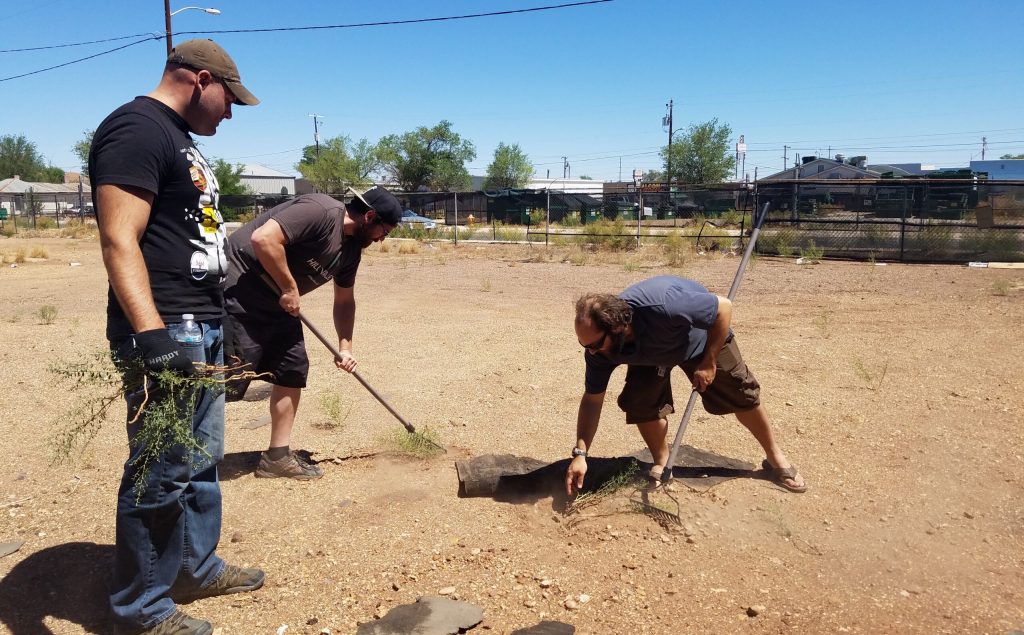
United States Army veteran William Thomas has come to Winslow from New Jersey on a mission. He and his team have begun construction on what he calls “Veteran’s Greenhouse.”
“What we are doing is we are trying to feed the needy, we are trying to work with local churches to give fresh produce to people who need it,” Thomas explained. “We are trying to help veteran’s first; that is my main goal.”
Thomas spent 11 years in the United States Army where he was educated in computer sciences and technologies. His background in technology lends itself to the systems he plans to use to grow food. “I studied signal and communications and a lot of different types of computer science.”
Thomas also worked for a company in New Jersey that developed an innovative surgery using radio waves. “Those are the same principles I’m going to be using,” he said. He explained that the greenhouse operation will be fully automated using various technologies such as robotics and computer coding.
The Veteran’s Greenhouse will incorporate methods of aquaponics to grow food. Aquaponics, according to Matthew Chadwick, the group’s communications representative is, “A combination of two separate biological studies. Aquaculture and hydroponics. Aquaculture is the farming of fish under manmade conditions and hydroponics is the method of growing plants without the use of soil.”
The many benefits of aquaponic farming were outlined in the group’s grant proposal. Chadwick said, “The yields achieved by aquaponic systems per square foot of grow space vastly exceed soil grow.” The crops produced in the Veteran’s Greenhouse will be sold in Winslow and surrounding communities to help support the operation.
Winslow’s high desert may not seem like the ideal environment for growing food, but as the group’s secretary Kevin Murray said, “A greenhouse is a controlled environment.” He mentioned the ease with which the Veteran’s Greenhouse has been able to acquire land and backing from the local government and citizens. “There are a lot of reasons why we should be doing this in Winslow. Winslow is a desert climate, so it is dry, arid and hot so it’s difficult to grow some of the crops we are trying to grow. Climate change is one of the primary concerns of our project, if we can grow industrial levels of produce here, we can do it anywhere,” said Murray.
Thomas explained that the desert environment of Winslow is ideal for their concept of meeting the challenge of drought areas being developed for agriculture.
Thomas plans to employ veterans to work in the greenhouse, as well as teach them the methods of sustainability that he is hoping to develop. “Once these guys ‘graduate’ from my program and they learn what they need to, I want them to go out and start their own greenhouse and teach even more people how to grow food,” he said.
Thomas emphasized the desire to help the Native American veteran community, specifically by partnering with the Navajo and Hopi nations and by reaching out to its veterans in multiple ways. “We are actually going to try to work with the VA (Veteran’s Affairs) to build a VA outpatient clinic here in town for the veteran’s that live on the reservation,” said Thomas. “We (veterans) are not transitioned easily into society so I would like to make a place where they can go, where all veterans can go, to talk to other veterans and be around other veterans that understand them.”
Funding for such a grand undertaking is being sought. “Grants, STEM (Science, Technology, Engineering and Mathematics) grants, private donations, all of those are coming in,” Thomas said. “We will be applying for an Indian Reservation grant but, we of course need more.”
Chadwick added, “There are a ton of different agricultural grants, educational grants and Native American grants. I am the one pushing the papers through the grant process and there are hundreds.”
As for now, according to Thomas, “We are waiting for money to come through. We have had talks with corporations and individual donors, but we are waiting for the money to come through.” He said, “I have joined the alliance of non-profits of Arizona, but it is a long process before we can get large donations and they are beneficial to those companies.”
For more information on Thomas and his team and the Veteran’s Greenhouse project, visit their website at www.veteransgreenhouse.org or their Facebook page, facebook.com/vet.greenhouse.