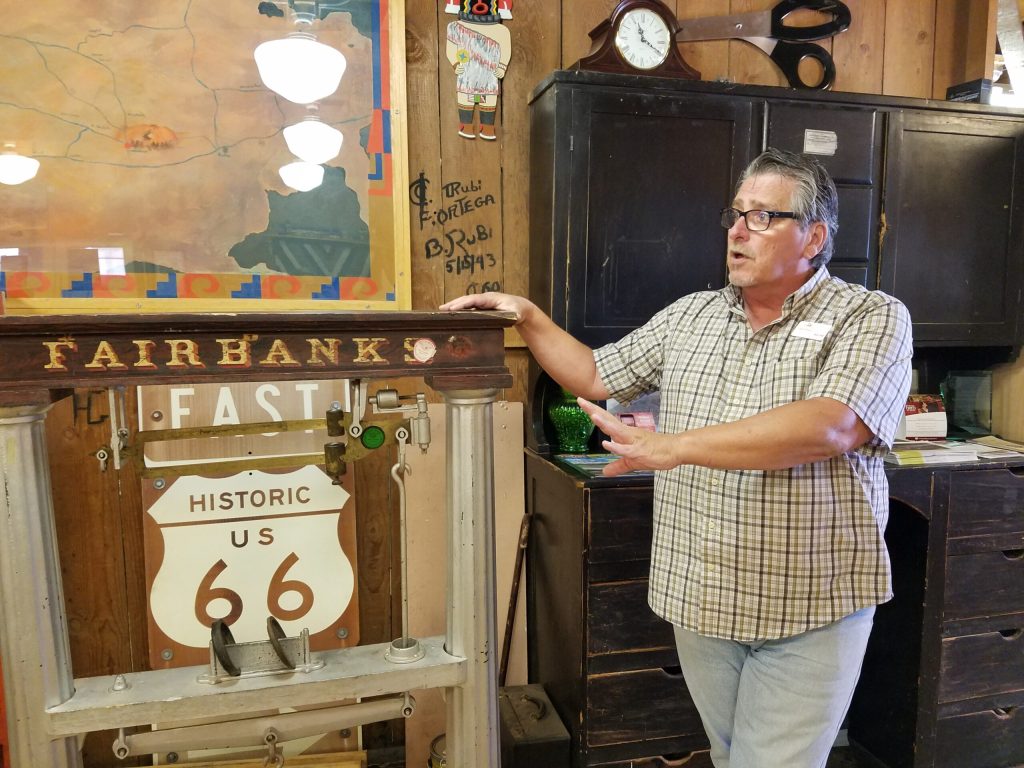
The building historic Hubbell Trading Post, which now houses the Winslow Visitor’s Center and the Winslow Chamber of Commerce, recently celebrated its centennial birthday. The community was treated to refreshments and history displays presented by the center and the Old Trails Museum.
Winslow Chamber of Commerce CEO Bob Hall said, “This building is 100 years old, we are very proud of it. The Chamber of Commerce and the City of Winslow are proud to have saved this national treasure that we are still enjoying today.”
Constructed in 1917 from bricks made in Winslow by Fenton Brick Company and commonly referred to as the Hubbell Building, the structure located at 523 W. Second St. possesses a long and rich history. Hall explained the original owners were a group of businessmen by the name of Richardson. The Richardson brothers built the space to house a trading post to serve the rural area around Winslow, including the Navajo and Hopi reservations.
According to a written account by Vada Carlson and Joe Rodriguez in their book, A Town is Born, A Pictorial Review of Winslow Arizona, the Richardsons sold the trading post to Juan Hubbell in 1921. Hubbell owned and operated up to 30 trading posts around Arizona and New Mexico. “The Hubbell Trading Post in Ganado was and still is the longest continuously running trading post in the Southwest,” said Hall. Hubbell’s goal was to do the same in Winslow and he succeeded, as it became the main distribution and office site for the Hubbell Company. The Native Americans respected Hubbell, as he took the time to learn the Navajo language and culture.
He also served as sheriff, was a statesman in the Prescott area and was an integral player in gaining statehood for Arizona.
Hubbell’s sons, Lorenzo and Ramon, took on the Hubbell Trading Post near the railroad tracks on Second Street where wool from Navajo herders was the main export. The Hubbell Trading Post was so successful that a second building was needed for what Hall noted was a warehouse for “the stock piles of processed wool waiting to ship to textile mills on the East Coast.”
Navajos and Hopis from the surrounding reservations would come to the trading post to sell their wares, to stock up on supplies and, most importantly, to socialize. “Originally trading posts were where the Natives learned English, they learned commerce and they were also social centers,” Hall said.
“Trading posts began faltering when cotton took over as the most sought after fabric and as they became tourist attractions more than trade centers,” he continued. In an effort to market the Hubbell Trading Post, Lorenzo Hubbell commissioned the world’s largest seamless Navajo woven rug in 1932. Weaver Julia Joe was a customer of Hubbell’s at the Ganado trading post. She and her husband Sam took on the project. “They used wool from 78 head of sheep. It took two years to process the wool, and three years and three weeks to weave the rug,” Hall recounted.
The rug is 26’x36’ and weighs over 250 pounds. The Joe family was paid $2,000 for their work and the rug is now worth over $1 million. It belongs to the Winslow Arts Trust.
The Hubbell family maintained the post until 1952 when they were forced to declare bankruptcy. “We aren’t sure exactly why the business went under,” Hall said, “but it is well known that Lorenzo extended a lot of credit; that could have contributed.”
Records from the Winslow Historic Preservation Commission provided by Chairman Kenn Evans revealed the sale of the Hubbell in the late 1960s. Real estate developer Kyle Bales, who now has a street named for him in the Winslow Plaza subdivision, took over the business alongside his daughter Patricia Smith until 1972. When Bales and Smith left, they offered it to the Winslow Historical Society, whose members encouraged the city to purchase the building.
According to the application for the National Register of Historic Places submitted in 2002, it was Patricia Smith who protected the artifacts and fixtures in the building. The city did purchase the space and over the course of the next few decades, it housed offices for Arizona State Parks, a Native American Artist’s Co-Op and the Affiliation of Arizona Indian Centers, Inc.
According to Hall, in the early 1990s volunteer grant writer and Winslow resident Eloise DeSpain applied for a small grant that made it possible to fix the roof on the building. “Had that not happened, we would have lost this place,” he said.
In the early 2000s the Arizona Department of Transportation (ADOT) claimed eminent domain on the site of the visitor center on the north side of town for construction of an overpass. The City of Winslow received approximately $200,000 from ADOT and decided to use that as seed money to restore and move into the Hubbell Trading Post building.
Hall remembered historic architect Doug Stroh being hired to restore the building with emphasis on keeping as many original features as possible. A four-year project of restoring floors, ceilings and the rough-cut lumber walls began in 2004. As grants, donations and subsidies from the city trickled in, “we had all the electrical and plumbing redone, and the basement was sealed, because it was leaking,” he said.
Office space, heating and cooling, landscaping of the grounds and an historic replication of the awning on the front of the building were also completed.
“We were able to salvage a number of original fixtures and features, including the large scales used for weighing goods at the trading post,” said Hall, who moved the visitor’s center and Chamber of Commerce headquarters into the building in 2009.
“It is not just a visitor center building with a bunch of brochures. It’s a museum, and it’s really an Arizona treasure in and of itself, a destination,” according to Hall.
The downtown Winslow area continues to grow and many, including Hall, credit the restoration of the Hubbell Building with starting the push. “The renaissance of Winslow would not be happening if we hadn’t realized what we needed to embrace, our history,” he noted.
To enjoy the history of the Hubbell Trading Post and to learn more about Winslow’s role in Native American trade, visit the Winslow Visitor’s Center from 9 a.m. to 5 p.m., Monday through Friday, and from 9 a.m. to 3 p.m. on Saturdays.