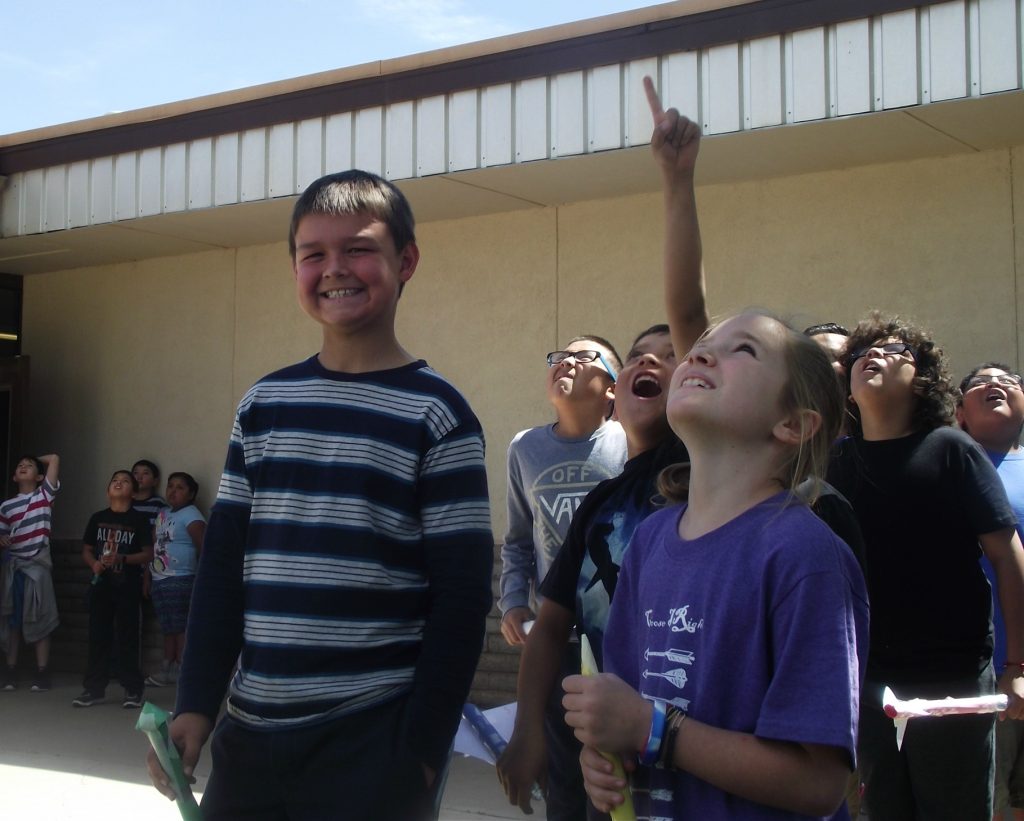
In conjunction with a grant from Arizona Public Service Co., the Arizona Science Center took over the elementary schools in Winslow last week. Each school, Bonnie Brennan Elementary School, which serves preschool, kindergarten, third and fourth grade students, Jefferson Elementary School, first and second graders, and Washington Elementary Schools, fifth and sixth graders, participated in Science, Technology, Engineering and Mathematics (STEM) Week to help engage students, as well as teachers, in the careers available in those fields.
STEM education is an important part of the Winslow Unified School District’s curriculum. Educators are always welcoming of interactive programs to help pique the students’ interest in the sciences and math. According to the U.S. Department of Commerce, “STEM education creates critical thinkers, increases science literacy and enables the next generation of innovators. Innovation leads to new products and processes that sustain our economy.”
Careers in science and mathematics fields are the fastest growing in our economy, expected to increase about 28 percent, compared with the average 6.5 percent projected growth for all other occupations before the year 2024. Many schools are taking advantage of the Arizona Science Center’s traveling programs, as they have the potential to ignite desire to pursue these vocations.
Last week’s activities included engineering projects in which students were encouraged to think through the building of rockets and rollercoasters. Presenters from the Science Center held discussions on how these things work and why, then provided guidance and materials for the students to build their own.
At the conclusion of the rocket presentation, the kids loaded the rockets onto an air-powered launcher and sent them in to the sky. The hands-on learning fascinated students from kindergarten to sixth grade.
Other presentations were on chemistry, computer coding, puzzles and a planetarium. An inflatable dome was set up to house the planetarium, and was an absolute hit with students and teachers.
While students participated in experiments and discussions, teachers at each school attended training on how to implement STEM techniques in to their classrooms. Dr. Rob Robertson, vice president of Professional Learning and Development at the Arizona Science Center, believes that one way to make STEM accessible to all students, and “help them really learn, is through project and problem based learning.”
Robertson speaks at many conferences and summits throughout the state, instructing educators on how to use what they are already teaching in mathematics and sciences to further learning on technologies the students may not have experience with. For example, Robertson recounted a story of high school students who were given a project on solar go-carts. One student explained they had no idea what an automobile was made of or how it worked, and was inspired to research beyond the assignment.
It is the goal of classroom instructors everywhere to get students thinking beyond what they were assigned, and many believe this is the best way for students to retain information on these advanced subjects and concepts.
Winslow School District officials plan to continue to teach STEM initiatives in the future, and realize the importance of engaging students in tangible ways. The staff at each of these schools is dedicated to educating further generations of inventors, mathematicians, scientists and engineers.
Academic Coach Amanda Leonard said, “We made sure that no student missed out on this week; this could change a kid.”