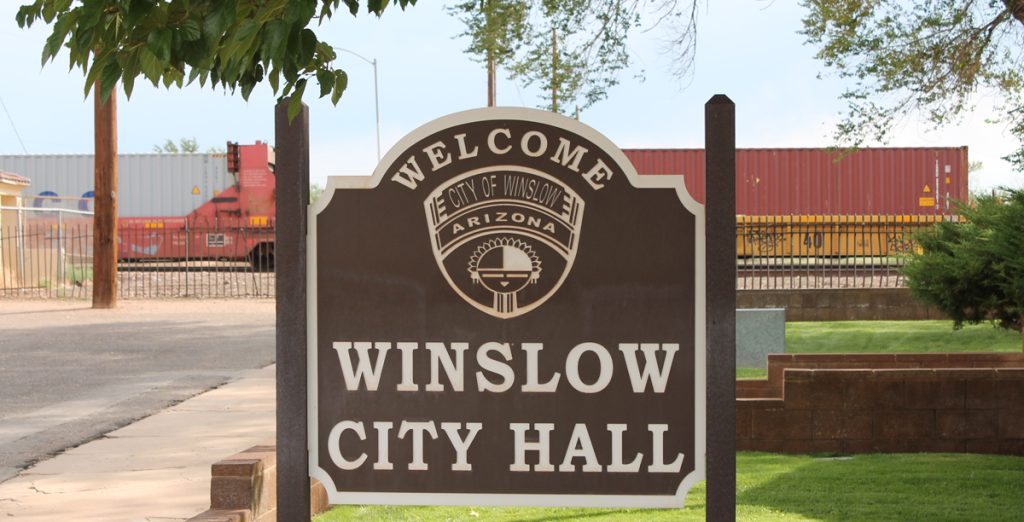
The Winslow City Council met June 28 to discuss the proposed Navajo Nation conciliation measures.
Rodney Tahe, speaking for Navajo Human Rights Commission Director Leonard Gorman, conducted the discussion of the conciliation measures proposed by the commission.
A key point was informing the council that the Navajo Nation’s courts can order that a person with severe alcohol problems be mandated to undergo treatment. He said that this is being done in Gallup, N.M., and could be done in Arizona.
New Mexico has excise taxes on alcohol in cities and counties, which are used to fund detox centers. This could be done in Winslow or in Navajo County as a whole.
Dr. Lula Stago noted that Winslow is a very diverse community, but could be made better if a way is found to get those needing treatment.
Tahe spoke about issues with law enforcement, but said that he was pleased that Winslow Police Chief Steve Garnett has a ride-along program. He said that a task force to work with police would also be helpful.
Teesto Chapter President Elmer Clark suggested that a cultural diversity study would be beneficial.
It was also suggested that the city should make changes to stop having water shut off for late payments. City Manager Stephen Pauken said that it would be looked into to see what could be done.
Mayor Robin Boyd said we should look into the possibility of a tax on alcohol, and deemed the meeting worthwhile.
District II Navajo County Supervisor Jesse Thompson noted that he appreciates that the city, the tribe and the county are working together to try to solve a problem that has long plagued the area.
Following the meeting, Pauken said that he has been in contact with people from the tribe, and cities and counties in border towns in Arizona and New Mexico. He noted that the key to solving this problem is working together, as it is a regional problem.
The five points in the memo to the council included:
* Establish rehabilitation and shelter programs in Winslow.
* Community involvement in law enforcement.
* Account for contributions of Native Americans.
* Change policy to address late payments and reconnection fees.
* Other issues, including certifying businesses, cultural sensitivity training for government employees, instituting a two percent alcohol excise tax and assessing community cohesiveness.